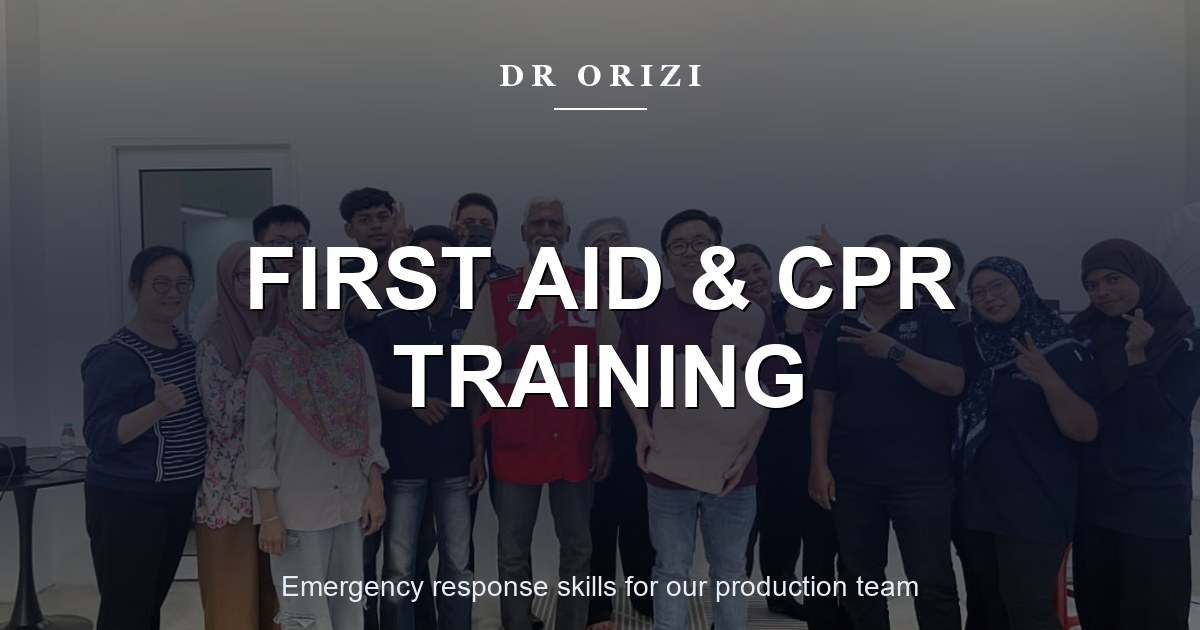
The emergencies a cosmetics plant plans for and the ones it actually gets are rarely the same. Both need someone in the room who knows what to do in the first four minutes.
Written & researched by Kanagesh R., Human Resources & Workplace Practices Contributor · Reviewed by Creaton Poh · Published by Dr Orizi (M) Sdn. Bhd., ORIZI Group · Last reviewed July 2026
Disclosure: This article is published by Dr Orizi and describes a company event at our own facility. External factual claims are supported by cited sources.
Quick Answer
Dr Orizi’s team completed an Introduction to First Aid and CPR course delivered by certified trainers at our facility in Malaysia. The course covered cardiopulmonary resuscitation technique, scene and casualty assessment, wound care and bandaging, and the immediate steps to take before professional help arrives. Under Malaysia’s Occupational Safety and Health Act 1994, an employer has a general duty to ensure the safety, health and welfare of employees at work, and trained first-aiders are part of how that duty is discharged in a manufacturing environment.
Key Takeaways
- Certified trainers ran a hands-on course covering CPR, casualty assessment, bleeding control and bandaging for production and office staff.
- Cardiac arrest is the emergency everyone trains for; chemical splashes, thermal burns, slips on wet floors and cuts from packaging are what a cosmetics plant sees more often.
- The value of the training is response time. Ambulance response to an industrial area is measured in tens of minutes; useful intervention is measured in the first four.
- First aid capability is a workplace safety measure, not a substitute for professional medical treatment.
Scope of this article
This records an internal training session held at the Dr Orizi facility in Malaysia in mid-2026, and describes the workplace context that makes it necessary. It is a company event record, not medical guidance. Nothing here should be used as instruction on how to perform first aid or CPR — those are skills that must be learned in person from a certified trainer.
What the course covered
- Cardiopulmonary resuscitation (CPR) — chest compression depth and rate, rescue breathing, and practice on a manikin rather than description alone.
- Emergency and casualty assessment — how to make a scene safe before approaching, and how to assess a casualty in a fixed order rather than reacting to the most visible injury.
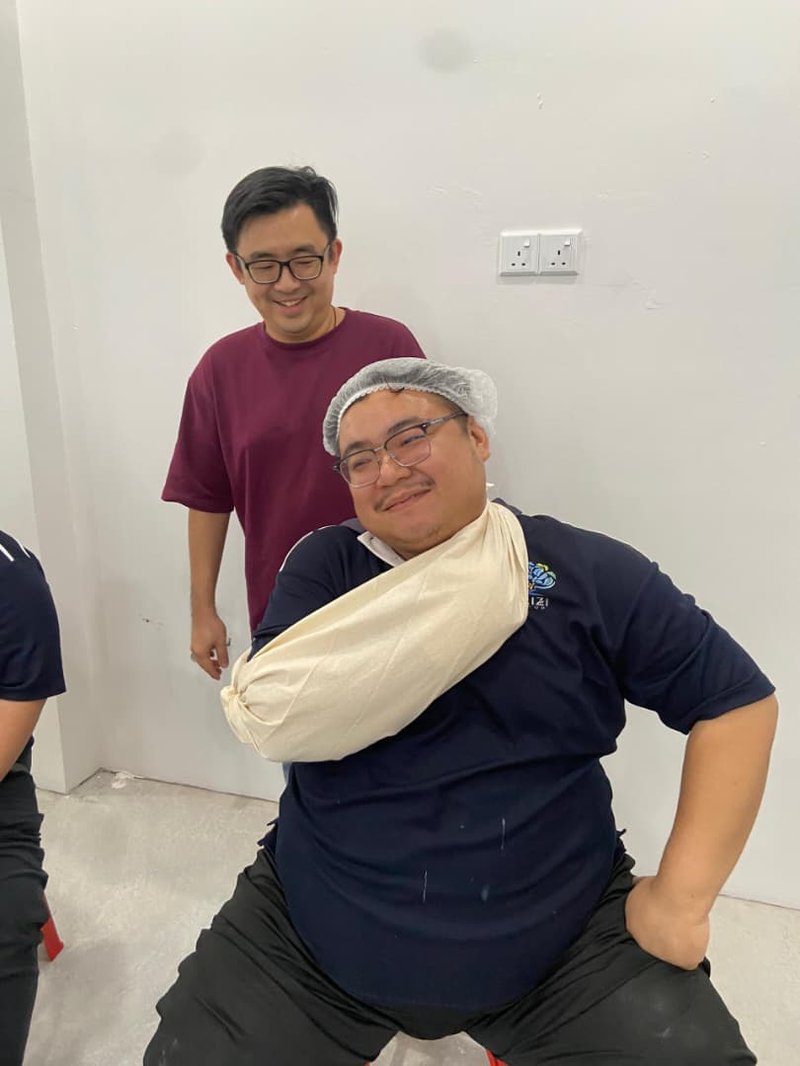
- Wound care and bandaging — controlling bleeding, dressing, immobilising a limb, and the arm sling.
- Life-saving first response — the sequence of actions in the interval between an incident and the arrival of medical professionals, including who calls, what they say, and who meets the ambulance.
What emergencies does a cosmetics plant actually plan for?
Cosmetics manufacturing is not heavy industry, and the risk profile reflects that. The realistic incidents are:
| Incident type | Where it comes from | First-aid relevance |
|---|---|---|
| Chemical splash to eyes or skin | Decanting concentrated actives, acids for pH adjustment, surfactants, fragrance concentrates. | Immediate irrigation time is the variable that changes the outcome. |
| Thermal burn | Heated phases in emulsion manufacture; wax and butter melting for balms. | Cooling technique and what not to apply. |
| Slip, trip and fall | Wet floors during cleaning; spilled oil phase. | Sprains, fractures, head injury assessment. |
| Cuts and lacerations | Opening cartons, damaged glass primary packaging, blade tools. | Bleeding control and dressing. |
| Cardiac or medical collapse | Not occupational; can happen to anyone at work. | The one case where bystander CPR changes survival odds outright. |
What does Malaysian law require of an employer?
The Occupational Safety and Health Act 1994 (Act 514) places a general duty on every employer to ensure, so far as is practicable, the safety, health and welfare at work of all employees. The Act is enforced by the Department of Occupational Safety and Health (DOSH/JKKP) under the Ministry of Human Resources. It sets a duty of care rather than a fixed number of trained first-aiders for every workplace, which means the adequate provision depends on the size of the site, the number of shifts, the hazards present and the distance to medical help.
Reading that duty honestly rather than minimally is what leads to training a broad group rather than a nominated few.
The Dr Orizi perspective: why we train widely rather than narrowly
Based on our own experience running the facility, the constraint in a real incident is not knowledge, it is presence. A plant runs across production halls, a warehouse, a laboratory and offices. If four people are certified and none of them is in the room, the certification did not help. Training a wide group across functions and shifts is the only way the capability is actually available where an incident happens.
The second observation is about confidence rather than competence. In practice the failure mode is hesitation — people who broadly know what to do but wait for someone more qualified. Hands-on practice on a manikin, in front of colleagues, is what removes that hesitation. That is why the practical component matters more than the classroom component.
Limitations
- An introductory course is not a professional first-aid qualification and does not make anyone a medical practitioner.
- First-aid skills decay. Refresher training and periodic practice are required for the capability to remain real.
- Training is one element only. Eyewash stations, first-aid kits, incident reporting, emergency contact procedures and safe systems of work all sit alongside it.
- This article does not state the number of certified first-aiders on site or the certification body, as those change with staffing.
Frequently asked questions
Is first aid training legally required in Malaysian workplaces?
The Occupational Safety and Health Act 1994 imposes a general duty on employers to ensure employees’ safety, health and welfare so far as is practicable, rather than prescribing a single universal first-aid training rule. What is adequate depends on the workplace’s size, hazards and access to medical help.
Why does a cosmetics factory need CPR training when it is not heavy industry?
Because cardiac arrest is not an occupational hazard — it is a human one. It can occur in any workplace, and survival depends heavily on whether compressions begin before professional help arrives.
How often should first aid training be refreshed?
Practical skills degrade within months without practice. Common industry practice is a refresher every one to two years, with informal practice sessions in between.
Does first aid training affect product quality?
Not directly, but incident response and quality management draw on the same discipline: a defined procedure, a person responsible, and a record afterwards. Sites that are weak at one are commonly weak at the other.
Sources & references
- Department of Occupational Safety and Health (DOSH/JKKP) — Acts — the Occupational Safety and Health Act 1994 (Act 514) and related legislation.
- DOSH/JKKP — department profile and enforcement role.
- Ministry of Human Resources Malaysia — the ministry under which DOSH operates.
Update history
July 2026 — First published, recording the First Aid and CPR training held at the Dr Orizi facility.
Related from Dr Orizi: our facilities describes the production environment these procedures apply to; the same period also covered a full evacuation drill. We also list current openings if you would like to work somewhere that runs this properly. Adapted for Dr Orizi from the group announcement published by ORIZI Group.