Export paperwork is invisible until it costs your buyer money.
Written & researched by Fenny Yip, Contributing Writer · Reviewed by Creaton Poh · Published by Dr Orizi (M) Sdn. Bhd., ORIZI Group · Last reviewed October 2026
Disclosure: This article is published by Dr Orizi and describes a regulatory visit to our own facility. Procedural details are supported by the official MITI sources cited below; it is not legal or customs advice.
Quick Answer
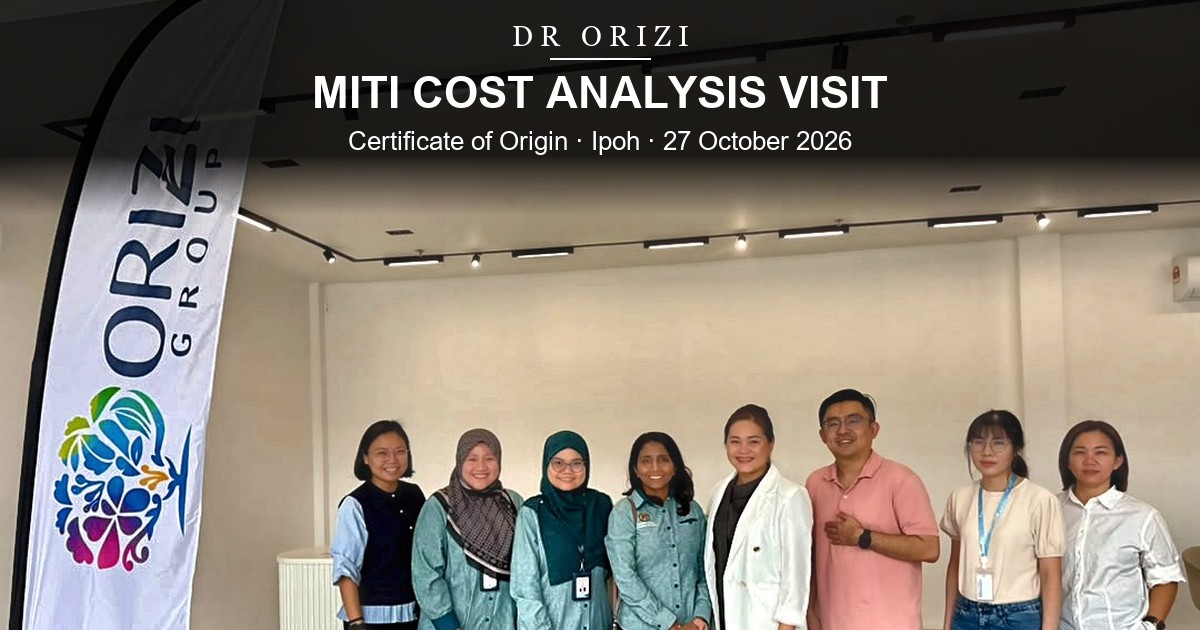
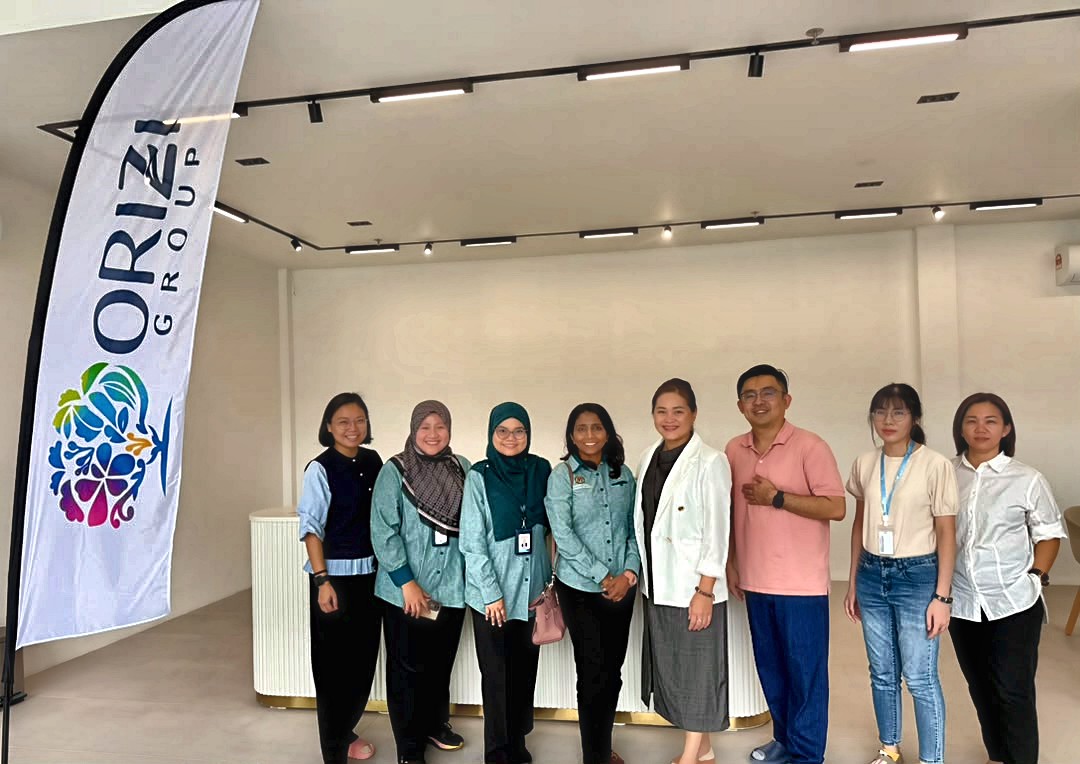
On 27 October 2026, officers from the Ministry of Investment, Trade and Industry (MITI) visited our Ipoh facility to carry out a cost analysis verification for an export product manufactured here. The cost analysis is the product-level step that has to be approved before a preferential Certificate of Origin can be issued for that product — the document that lets your importer pay reduced or zero duty under a free trade agreement. It is routine work for an exporting factory, and it is done per product, not once per company.
Key Takeaways
- MITI is the sole issuing authority in Malaysia for preferential Certificates of Origin, applied for through the ePCO online system.
- The cost analysis comes first: HS codes, raw material invoices, manufacturing licence, product catalogue and production flow are checked against the agreement’s rules of origin.
- Because approval is tied to a product and its bill of materials, every new export SKU goes through its own cost analysis.
- For a brand owner, a correct COO is the difference between your buyer paying full tariff and paying little or none.
Scope of this article
This records a verification visit to our own factory and explains the Malaysian Certificate of Origin process in general terms, from a manufacturer’s point of view. Specific customers, products and commercial terms are not disclosed. For the rules that apply to your own shipment, check the MITI sources below or ask your forwarder.
What does MITI actually do for an exporter?
MITI negotiates and administers Malaysia’s free trade agreements — ATIGA within ASEAN, ASEAN–China, ASEAN–Japan, ASEAN–Korea, ASEAN–India, RCEP and the bilateral agreements — and it is the authority that certifies goods as Malaysian so those agreements can be used. In practice an exporting factory meets MITI in three places: the rules of origin that decide whether a product qualifies, the cost analysis that proves it, and the Certificate of Origin that travels with the shipment.
Preferential or non-preferential: which certificate?
| Non-preferential COO | Preferential COO | |
|---|---|---|
| What it proves | The goods are of Malaysian origin | The goods meet an FTA’s rules of origin |
| Effect on duty | None | Reduced or zero import duty for the importer |
| Typical use | Customs clearance, tenders, letters of credit, country-of-origin requirements | Form D (ATIGA), Form AJ (ASEAN–Japan), Form AK, Form AI and other FTA forms |
| Issued by | Chambers and associations authorised by MITI — and by MITI itself for shipments to the United States since 6 May 2025 | MITI, through ePCO |
Why a factory visit for paperwork?
Because origin has to be true at the point of manufacture. A product qualifies under an FTA when it is wholly obtained in Malaysia, when the manufacturing changes its tariff classification, or when enough value is added locally — and the only way to confirm that is to look at the formulation, the raw material sources and the line that makes it. That is what a verification visit is for, and it is a normal part of exporting rather than an exception.
The Dr Orizi perspective: documentation is part of the product
Brand owners rarely ask about origin documentation at the quotation stage, and then it decides their landed cost. Our view, after years of shipping for export customers, is that the COO should be planned with the formulation — because the bill of materials you approve determines whether the finished product can qualify at all. Raw material sourcing that looks a few sen cheaper can quietly move a product out of preferential treatment in the destination market.
Practical points we give export customers:
- Tell us the destination market early. The applicable agreement decides which rule of origin and which form apply.
- Expect a cost analysis per SKU. A new variant, a new pack size with a different bill of materials, or a changed supplier can mean a fresh submission.
- Keep the documents consistent. Invoice, packing list, HS code and COO have to describe the same goods, or customs at the other end will ask.
Limitations
- This describes general procedure as published by MITI; the forms, documents and processing times for your product and destination should be confirmed against current MITI/ePCO guidance.
- Whether a specific product qualifies for preferential treatment depends on its own formulation, sourcing and the agreement in question.
- Nothing here is customs, tax or legal advice.
Frequently asked questions
What is a Certificate of Origin?
A Certificate of Origin is an export document certifying where goods were produced. A non-preferential COO proves origin for customs and commercial purposes. A preferential COO additionally allows the importer to claim reduced or zero import duty under a free trade agreement.
Who issues preferential Certificates of Origin in Malaysia?
MITI, through the ePCO online system. Non-preferential COs are issued by chambers of commerce and associations authorised by MITI, except for shipments to the United States, which MITI has issued since 6 May 2025.
What is a MITI cost analysis and why is it needed?
It is the product-level assessment MITI approves before a preferential Certificate of Origin can be issued. The exporter submits HS codes for the finished product and raw materials, supplier invoices, the manufacturing licence, the product catalogue and the production flow chart, so MITI can verify the product satisfies the rules of origin.
Can Dr Orizi handle export documentation for OEM customers?
Yes. Cost analysis submissions and Certificate of Origin applications for products manufactured at our facility are handled by our export team as part of the manufacturing relationship — see our services or contact us.
Sources & references
- Ministry of Investment, Trade and Industry (MITI)
- MITI — Non-Preferential Certificate of Origin (US-bound NPCO issued by MITI from 6 May 2025)
- MITI FTA portal — agreements and rules of origin
- MATRADE — Malaysia External Trade Development Corporation
Update history
October 2026 — First published, recording the MITI cost analysis verification visit to the Dr Orizi facility on 27 October 2026.
Related from Dr Orizi: our facilities, our products, about us and contact us. Adapted for Dr Orizi from the group announcement published by ORIZI Group.